
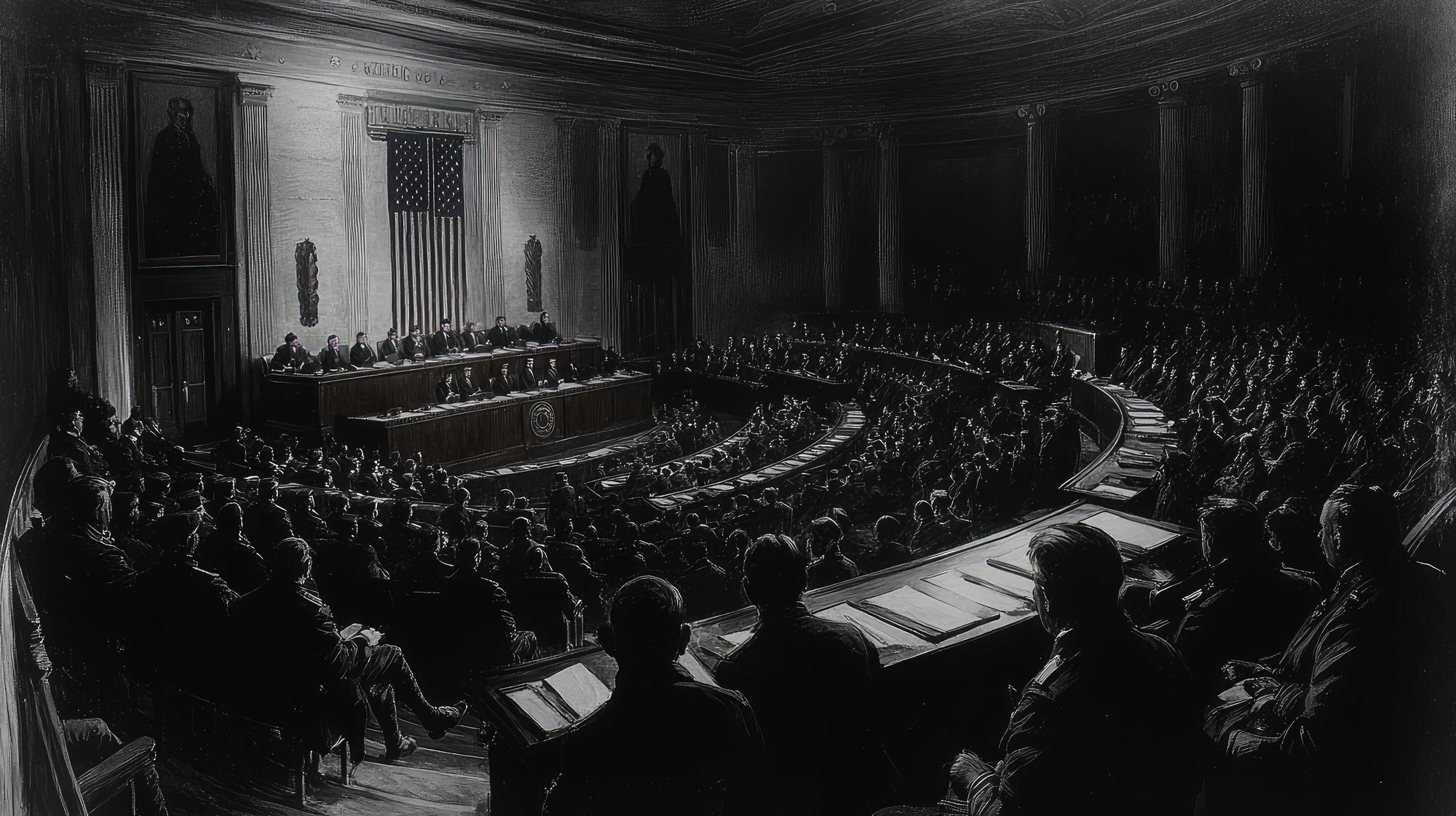

A flowchart of how a bill becomes a law maps the decisions that move a federal proposal through Congress to enactment—or stop it along the way. The diagram below follows the decisions from introduction through enactment or a stop; the text explains each stage.
In This Article
- Follow the Branches From Introduction
- Introduction and Committee Review
- Floor Votes in Both Chambers
- Both Chambers Must Agree on the Text
- The President’s Decision and the Clock
- Key Takeaways
- Frequently Asked Questions
- Follow the Decisions, Not Just Arrows
Follow the Branches From Introduction
This diagram follows an ordinary bill through the U.S. Congress to presidential action and possible enactment. “First chamber” means whichever chamber introduces it; “second chamber” means the other. Each question marks a decision, not an automatic next step.
Bill introduced in first chamber
                |
                v
Committee review: Does the bill advance? -- No --> Stops unless revived
                | Yes
                v
Scheduled for floor action? -- No --> Stops unless revived
                | Yes
                v
First chamber passes? -- No --> Stops unless revived
                | Yes
                v
Second chamber committee review: Does the bill advance?
                | No --> Stops unless revived
                | Yes
                v
Scheduled for second chamber floor action?
                | No --> Stops unless revived
                | Yes
                v
Second chamber passes? -- No --> Stops unless revived
                | Yes
                v
Both chambers approve identical text?
   | No --> Amendment exchange or conference
   |          |
   |          v
   |        Required approval votes on revised text
   |        (Amendment exchange: concurrence votes as needed;
   |         conference: votes in both chambers)
   |          |
   |          v
   |        Both chambers now approve identical text?
   |          | No --> Repeat negotiations or stop
   |          | Yes --> Enroll and present to President below
   | Yes
   v
Enrolled bill presented to President
   |
   +--> Signs --> LAW
   |
   +--> Returned veto --> Both chambers override?
   |                       (Two-thirds voting; quorum present)
   |                         | Yes --> LAW
   |                         | No --> NOT LAW
   |
   +--> No signature or return within 10 days after presentation,
        excluding Sundays --> Adjournment prevents return?
                                | Yes --> Pocket veto: NOT LAW
                                | No --> LAW
“Stops unless revived” leaves open the possibility of further action during the same Congress. Some measures advance through procedures that bypass ordinary committee consideration, so a committee dead end is not always permanent.
Introduction and Committee Review
A member introduces a bill in the U.S. House of Representatives or the U.S. Senate. A bill receives a designation such as H.R. for a House bill or S. for a Senate bill. Introduction formally begins consideration; it creates no obligation to hold a vote.
The introduced bill usually goes to a committee with jurisdiction over its subject. Committee members may hold hearings and revise the text in a meeting called a markup. They can recommend passage, reject the proposal, or leave it without further action. Subcommittees may handle part of this work.
Committee approval still leaves a scheduling decision before the full chamber considers the measure.
How a bill becomes a law flowchart: checkpoints before passage
| Flowchart checkpoint | Who acts | What the checkpoint means | Why the next arrow is not automatic |
|---|---|---|---|
| Proposal drafted | Prospective sponsor and legislative counsel | Legislative text is prepared for possible introduction | A draft has no bill number and may never be introduced |
| Bill introduced | House member or senator | Bill receives an H.R. or S. number in the current Congress | Introduction does not require a hearing or floor vote |
| Committee referral | House Speaker or Senate presiding officer, under chamber rules | Bill is assigned to committee jurisdiction; multiple referrals are possible | Referral creates no deadline for committee action |
| Committee hearings | Committee or subcommittee members and witnesses | If held, hearings gather testimony and examine the proposal | Hearings do not approve the bill; the committee may stop work |
| Committee markup | Committee or subcommittee members | If held, members consider text changes and vote on amendments | Amending a bill does not itself send it to the floor |
| Ordered reported | Full committee | Committee votes to send the measure to its chamber, often with recommended amendments | Committee approval is not passage by the House or Senate |
| Floor scheduling | House leadership and often Rules Committee; Senate leadership and senators | Chamber procedures establish when and how floor consideration can begin | Calendar placement alone does not guarantee debate or a vote |
| Floor vote in the originating chamber | House members or senators | A passage vote decides whether that chamber approves the bill | One chamber’s passage is not law; both must pass identical text |
The table covers drafting and introduction through committee review, reporting, scheduling, and a floor vote. No checkpoint guarantees the next, and one chamber’s passage is still short of becoming law.
Floor Votes in Both Chambers
On the floor, members debate the bill and may consider amendments under their chamber’s rules. Ordinary passage normally requires a simple majority of members voting in each chamber, with a quorum present. That is different from a requirement that a majority of all seats vote yes.
A quorum is a majority of the chamber’s membership. With that quorum present, absences and members voting “present” can affect the number of affirmative votes needed. This is why a flowchart should label the decision “passes?” without suggesting that every bill needs the same fixed vote count.
Passage in the first chamber sends the proposal to the other chamber, where committee review and floor consideration may follow. Approval by the House alone does not complete congressional action.
Both Chambers Must Agree on the Text
The second chamber may pass the version it received or change it. If it changes the bill, the chambers must settle their differences before sending anything to the President. Agreement on the general goal is insufficient: both must approve identical legislative text.
They can exchange amendments until they agree, a process often called amendment exchange or “ping-pong.” Alternatively, a conference committee can negotiate a compromise that returns to both chambers for approval. A conference agreement cannot skip those votes. Once the text matches, the bill is enrolled for presentation to the President of the United States.
The President’s Decision and the Clock
Article I, Section 7 of the U.S. Constitution governs this stage. The President can sign a bill into law or return it with objections, which is a veto. Following a returned veto, Congress can enact the measure with a two-thirds vote of members present and voting in each chamber, with a quorum present. An override attempt that falls short does not enact the bill.
Presidential inaction follows a separate rule. If the President neither signs nor returns the bill within 10 days after presentation, excluding Sundays, it becomes law unless congressional adjournment prevents its return. When adjournment prevents return, the result is a pocket veto, and the bill does not become law.
A pocket veto has no override route because the bill has not been returned to Congress. A congressional break alone does not establish that this exception applies; the constitutional issue is whether adjournment prevents return.
Key Takeaways
- Introducing a bill starts consideration; it does not guarantee a vote.
- Committee review and scheduling are separate checkpoints where progress can stop.
- The House and Senate must approve identical text.
- A presidential signature enacts a bill, but a veto can trigger an override attempt.
- Presidential inaction has different outcomes depending on whether Congress can receive the bill’s return.
Frequently Asked Questions
What Is the Last Step in the Lawmaking Process?
The final step is enactment through presidential signature, congressional override of a returned veto, or presidential inaction under the conditions explained above. A law’s effective date may come later, so becoming law and beginning to operate are not necessarily simultaneous.
What Is a Bill?
A bill is a proposed law presented for congressional consideration. It may create a new legal requirement or amend or repeal an existing one.
How Are Laws Made?
For ordinary federal legislation, Congress approves a bill and completes the constitutional process involving the President. The bill to law route does not describe every congressional measure: a simple resolution, for example, concerns one chamber and is not presented to the President.
Can a Bill Start in Either Chamber of Congress?
Most bills can originate in either chamber. The Constitution requires bills for raising revenue to originate in the House, although the Senate may propose or concur with amendments.
Does Every Senate Bill Need 60 Votes to Pass?
No. The commonly discussed 60-vote threshold usually concerns invoking cloture to limit debate on legislation, not passing the bill itself. Cloture generally requires three-fifths of senators duly chosen and sworn; some procedures, including budget reconciliation, operate under different debate rules.
Follow the Decisions, Not Just Arrows
To understand where a proposal stands, identify its latest completed decision and the next unresolved one. “Passed the House” leaves Senate action ahead; “passed both chambers” still requires attention to whether their approved texts match. Congress.gov provides bill text and action histories that help distinguish these stages.
Read a diagram of how a bill becomes law as a branching process, not a timetable. A committee report signals progress, not guaranteed enactment. A presidential veto opens a different branch from presidential silence. Following those distinctions lets you explain both how a proposal can succeed and why it may remain unfinished, without assuming that an arrow promises the next step will happen.
Recommended for you

What Is a Diagram? Explanation, Not Just Illustration
What is a diagram? Learn how labeled shapes and connecting lines explain relationships, how diagrams differ from drawings, and how to read one. Read on.

Sin Graph From the Unit Circle: Five Points, One Wave
Build a sin graph from unit-circle heights and five key points. Learn amplitude, period, and shifts, then read equations from curves. See the steps inside.

Symmetric Histogram: Balance Beyond the Tallest Bar
A symmetric histogram mirrors bars around a center, not always its tallest peak. Compare tails and see how bin boundaries affect balance. Read the example.
Tree Diagram Rules: Clear Branches, No Loops Allowed
Learn how a tree diagram connects roots, children and leaves, then follow paths and calculate probabilities without confusing it with a flowchart. Read more.
Box Plot Reading: A Shorter Box Doesn’t Mean Faster
A box plot shows center and spread, not speed alone. Use task-time examples to compare medians and variability on the same scale. See the worked example.

Logarithmic Graph: Equal Ratios, Not Equal Differences
A logarithmic graph spaces 10–100 like 100–1,000. Separate log axes from log functions, read values, and plot curves with confidence. See how it works.

How to Find a Hobby That Truly Fits You
Give a hobby 21 days and 90 minutes per week, and you will learn more about your motivation, stress triggers, and attention than a dozen personality quizzes. A few concrete moves—testing a novel, a 5‑aside game, or a few low-stakes rounds of online gameplay—can reveal which activities calm your nervous system, sharpen focus, and actually […]

Histogram Patterns: What Clinic Waiting Times Reveal
A histogram turns clinic waiting times into visible clusters and gaps. Learn what bins and bar heights mean, and how to choose bin widths. See the example.