


Timeline ideas work best when their shape solves your immediate problem: a winding road follows a journey, parallel lanes expose overlapping work, and a circle shows a cycle that starts again. If your school play opens on Friday but the costumes and rehearsals are slipping on different days, you need lanes, not a decorative road.
The 16 options below range from string-and-clothespin displays to interactive histories. Each starts with what the format reveals, then puts it to work through a concrete example. Choose first whether you need to explain what happened or decide what must happen next; that distinction gives your timeline design a job.
In This Article
- 1. Winding-Road Timeline
- 2. Branching-Tree Timeline
- 3. Circular Timeline
- 4. Parallel Swimlane Timeline
- 5. String-and-Clothespin Timeline
- 6. Accordion-Fold Booklet
- 7. Classroom Wall Timeline
- 8. Autobiographical Timeline
- 9. Family History Across Generations
- 10. Relationship Story
- 11. Career Journey
- 12. Two-Week Sprint Timeline
- 13. Event Running Order
- 14. Archival Photo Timeline
- 15. Presentation Timeline
- 16. Interactive Multimedia Timeline
- Key Takeaways
- Frequently Asked Questions
- Choose One Story to Map
1. Winding-Road Timeline
A winding-road timeline places milestones along a curved path. It gives a journey recognizable stages without forcing every caption into a straight row. For a school play, stops labeled “Cast Selected,” “First Full Rehearsal,” and “Opening Performance” let the reader follow the production from auditions to the curtain.
Keep the bends readable, adding arrows where the direction could be mistaken. A creative timeline should leave room for the events that change the journey, including setbacks. Do not skip a setback that changes the schedule. Sample stops could read “Scene-Change Delay Identified,” “Revised Transition Rehearsed,” and “Opening Performance.” Add the relevant date beneath each label and a short caption explaining what changed. Keep these stops on the same path so the reader can follow the problem through to its resolution.
2. Branching-Tree Timeline
A branching tree shows how one beginning produces separate stories. The trunk carries the shared history; dated forks mark the point when people or activities take different paths. Time moves upward, so a branch that ends should stop instead of stretching toward the present.
For a hypothetical classroom example, begin with a student news club founded in September 2024. In January 2025, it divides into two independent groups: a newspaper team and a podcast team. Place that dated split at the fork. Continue the newspaper branch through its first issue in March and a special edition in June; continue the podcast branch through its first episode in April and an interview series in September. The trunk shows their shared beginning, while each branch carries its own subsequent history. Unlike parallel workstreams, these paths begin at a specific separation.
3. Circular Timeline
A circular timeline makes the return to the beginning part of the explanation. An annual membership cycle can move clockwise from recruitment through orientation and participation to renewal, with the starting point at the top.
Unequal stages need visible durations: equal arcs can make a short renewal window look as long as the participation period. For a sample annual cycle, label the stages “Recruitment,” “Orientation,” “Participation,” and “Renewal.” Put the renewal deadline beside its arc and mark when reminders must begin, rather than leaving readers to infer those dates from the ring.
If the ring represents a full year, give months fixed positions. If it represents stages alone, write the duration beside each arc. Renewal then reads as preparation for another round, not a ceremonial final slice.
4. Parallel Swimlane Timeline
Parallel swimlanes put related work in separate horizontal rows under one date axis. Among project timeline examples, they are especially useful when teams share a deadline but cannot simply work in sequence.
For an exhibition, use rows for conservation, interpretation, and installation. Label writing can continue while objects are prepared, but the installation row needs a connector from conservation approval. Keep the row order stable so readers can follow each team without hunting.
Check shared spaces as well as team deadlines. Add sample bars for “Unpack Crates” and “Measure Cases,” with the required room named beside each. If they overlap in the same room, mark a “Room Access Confirmed” milestone and assign an owner to resolve the conflict before either task begins.
5. String-and-Clothespin Timeline
Stretch string between secure supports and clip dated cards along it. The advantage is revision: students can move an event immediately when evidence changes its place in the sequence.
A local transportation history could pair a station photograph with separate cards for construction, opening, and later alterations. Put each date on the front and its source on the back. Turning over a disputed card makes the evidence part of the conversation instead of leaving it in the teacher’s notes.
Use lightweight copies, not original family photographs or archival material. Mark regular intervals if the string measures time; label it as sequence-only if it does not. The movable cards should make an argument easier to revise, not make its dates look more certain than they are.
6. Accordion-Fold Booklet
An accordion booklet opens a compact story into connected panels. A student newspaper issue supplies a bounded subject: the editorial meeting begins the strip, and publication ends it. A continuous line across the folds holds the sequence together when the booklet is extended.
The interesting panel may be the one between writing and printing. In a hypothetical student investigation, a draft article and a corrected proof could reveal that the headline changed after someone challenged its wording. Put both excerpts on that panel. Students then uncover a decision, not merely a production stage.
Identify the period on the cover and place longer explanations on the reverse. The interior should let readers trace how the finished issue became different from the one first proposed.
7. Classroom Wall Timeline
A classroom wall timeline stays visible as evidence accumulates over a semester or school year. Dated index cards can sit beside building photographs, yearbook pages, and accounts of curriculum changes. Leave gaps for discoveries that belong between existing entries.
For a documented example, use National Park Service records of Little Rock Central High School: the building was dedicated in September 1927, while the Little Rock Nine attended their first full day of classes on September 25, 1957. Place the records together and check the captions. Replace a broad label such as “School Opens” with separate labels for the building’s dedication and the Nine’s first full day.
That correction is the point of the display. Different card colors can distinguish photographs from written recollections, with a small legend, but the evidence must remain readable without the color code.
8. Autobiographical Timeline
An autobiographical timeline explains a change in your life through selected moments. Births and graduations provide anchors; they do not automatically explain the story. A timeline about independence might need a first solo trip or an apartment move more than another school-year marker.
“Moved to Phoenix” names an event. “Changed schools halfway through the year” gives it consequences. In a sample timeline, follow that entry with the first activity that made the new school feel familiar, then the decision to stay involved the following year. The move becomes a turning point with an aftermath, not a dot between birthdays.
Select entries by that relationship. If an event does not help explain the change you are tracing, it can belong in a different version of your life story.
9. Family History Across Generations
A family-history timeline aligns generations against shared year markers, revealing overlaps that a family tree leaves hidden. A grandparent’s first job might sit beside another relative’s school years; household moves can connect lives that otherwise occupy separate branches.
Separate arrivals deserve their own space. The Anne Frank House records that Otto Frank moved to the Netherlands in July 1933, Edith joined him in September, Margot arrived in December, and Anne followed in February 1934. Give each person a dated entry rather than compressing the family’s relocation into one household-move marker.
Those dates suggest the next useful question: whose arrival does each entry describe? Align the family members against the same year markers so readers can see the interval between their moves. The timeline distinguishes individual journeys instead of disguising them as a single family event.
10. Relationship Story
A relationship timeline works best when its artifacts carry details that an anniversary list would miss. A first meeting or shared move supplies the structure, whether the relationship is between partners, friends, or collaborators.
For a sample keepsake, place a ticket stub beside the first outing and a train receipt beside the first visit after a move. The receipt’s date may matter more than its appearance: it fixes a journey that memory has compressed into “that winter.” A dated photograph can show what happened at the destination.
A narrow horizontal strip suits those small objects; a vertical version leaves more room for captions. Let each caption explain why the artifact belongs. “Train receipt” identifies paper; “First visit after the move” identifies a change in the relationship.
11. Career Journey
A career timeline shows changes in responsibility, including moves that a conventional résumé might flatten. Bars can represent overlapping roles, so freelance work does not appear to stop when a full-time position begins.
Grace Hopper’s career offers a documented pivot. The National WWII Museum records that she became an associate professor of mathematics at Vassar in 1941, took leave to join the WAVES in 1943, and was subsequently assigned to Harvard’s Bureau of Ships Computation Project. Mark the leave and computing assignment separately, explaining the change in work rather than treating academic and naval titles as one promotion ladder.
Include promotions where they matter, but do not make upward rank the only available plot. Attach documented, shareable results to the relevant period. The reader should understand the pivot without needing to know how either employer ranks its titles.
12. Two-Week Sprint Timeline
A two-week sprint timeline distinguishes tasks that occupy time from milestones that mark decisions. Use a bar for building a prototype and a separate marker for its review. A dot alone cannot show how long another person must wait.
Do not schedule a review without checking the reviewer’s availability. Sample entries could be “Build Prototype,” “Prototype Review,” and “Apply Approved Changes.” Give the review a named owner and a confirmed time, then connect it to the dependent work so the team can see what remains blocked.
Google Sheets offers a timeline feature in eligible Google Workspace editions, but the useful part is the visible handoff, not the software. Draw only dependencies that change delivery. One consequential connector is more useful than a web that makes every task look equally urgent.
13. Event Running Order
An event running order answers “Who acts next?” with clock times and named responsibilities. Put times on the left and activities on the right. A workshop might begin with arrivals at 9 a.m., then move into the opening session and its first activity.
The working version needs cues that the audience version can omit. Beside a presenter’s entrance, identify who hands over the microphone. Beside a room change, reserve an explicit 15-minute reset. That interval belongs to the people moving furniture; it is not empty space available for an overlong introduction.
Read the schedule from each owner’s position. Someone should be able to find their cue without reconstructing the entire event from session titles. A running order succeeds when the next action is unambiguous.
14. Archival Photo Timeline
An archival photo timeline uses visible changes as evidence. NASA Earth Observatory’s “World of Change: Shrinking Aral Sea” provides a real example: dated satellite images from 2000 through 2018 document changes in the lake. NASA explains that the eastern lobe of the South Aral Sea disappeared completely in 2014, while water levels fluctuated in other years.
Choose images dated August 25, 2000, August 19, 2014, and August 21, 2018, and place their dates beneath them. Keep the same geographic area visible so readers can compare the water’s extent. Add intervening images from the archive to show that the sequence is not simply steady shrinkage: NASA describes annual fluctuations between 2009 and 2018. Caption only what each selected image shows, and distinguish those observations from explanations supplied by NASA’s accompanying text. Two endpoints establish a contrast, not the whole explanation.
Apply the same selection rule to your own archive: choose images that establish a change, such as a new building or publication format. Keep the year visually prominent.
15. Presentation Timeline
A presentation timeline must survive the brief time an audience has to read it. Do not crowd an entire career history into small decorative boxes. For a sample career slide, select “First Role,” “Technical Training,” “Career Pivot,” and “Current Work.” Keep dates in a consistent position and give the pivot a short caption explaining the change.
PowerPoint’s Basic Timeline SmartArt layout supplies editable milestones; Canva offers designed timeline templates. Choose the format your next editor can actually revise.
For creative timeline design, remove minor entries before shrinking the text. Then preview the slide at presentation size, not as a thumbnail. Give the turning point enough room for a caption that explains it; the audience should not need the speaker to decode the graphic.
16. Interactive Multimedia Timeline
An interactive timeline lets each milestone open into supporting media. TimelineJS, developed by Northwestern University’s Knight Lab, supports chronological multimedia stories from structured data, including a Google Sheets template.
Do not let an entry’s headline omit a condition stated in its supporting media. For England’s school-reopening timeline, use “Conditional Reopening Plan Announced” for May 10, 2020: the Prime Minister’s statement proposed a phased primary-school return no earlier than June 1. Add “June 1 Return Confirmed for Selected Year Groups” for May 28. Use the official GOV.UK statements as supporting material so readers can compare the proposal with its later confirmation.
The click now changes the reader’s understanding instead of merely adding atmosphere. Pair each entry with attribution and an explanation of what the media establishes. Put the essential qualification in the visible text as well: readers who skip the supporting material should still understand the announcement’s conditions.
Key Takeaways
- Match the shape to the relationship: a fork separates stories; a ring returns to its beginning.
- Give turning points more space than routine milestones.
- Let conflicting evidence remain visible instead of forcing certainty.
- Make handoffs explicit when another person’s work depends on a decision.
- Use media when it changes what the reader understands.
Frequently Asked Questions
How Do You Create a Good Timeline?
Write the question your timeline must answer before choosing its format. Draft the relevant events in plain text and record the source of each historical claim. An entry earns its place by helping answer that question, not simply by having a date.
What Does a Good Timeline Look Like?
Good timeline examples make the next step obvious without a spoken explanation. Keep dates in a consistent position and give color one defined job, such as identifying a workstream. If decoration competes with the sequence, remove the decoration.
What Are Some Ideas for a History Timeline Project?
Choose a history whose records let you compare change, such as a school building’s uses or a local newspaper’s development. Yearbooks and newspaper issues give you evidence to place beside the dates. Build the project around what changed, not a quota of events.
How Should a Timeline Show an Event Whose Exact Date Is Uncertain?
Print the uncertainty beside the event: “circa 1910,” “before 1945,” or a supported date range. A template’s demand for a day does not create evidence for one. Where accounts conflict, name the disagreement in a short note.
Should the Spaces Between Timeline Milestones Represent Elapsed Time?
Use measured spacing when duration matters; use equal spacing when sequence alone matters. Label an unscaled timeline of events so readers do not mistake equal gaps for equal intervals. Long stretches without entries should remain visible when those absences are part of the story.
Choose One Story to Map
Choose one format and sketch five dated entries before opening a design tool. Ask someone unfamiliar with the subject to trace the sequence and identify its turning point or next required action. Revise wherever they hesitate. That small test will show whether you need clearer labels, more space, or a different format.
Recommended for you
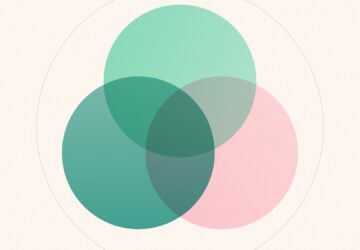
Venn Diagram: Why Club Rosters Can Count Students Twice
A Venn diagram explains how 18 art-club and 14 music-club members fit in a class of 30. Learn to read overlaps and avoid double counting. See how it works.

Stacked Bar Chart: Totals, Parts, and Shares Made Clear
A stacked bar chart shows totals and the parts behind them. Learn when to use counts or percentages, with a worked example and Excel steps. See the guide.
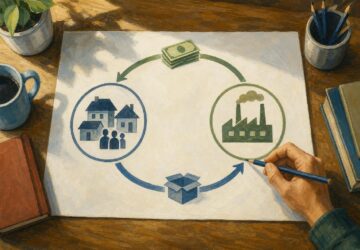
Circular Flow Diagram: A $4 Loaf Links Two Markets
A circular flow diagram connects a $4 bread purchase to work and income. Learn how goods and money move through two markets. Follow the example in the article.
Stem and Leaf Plot: Ordered Data, Every Value Visible
A stem and leaf plot keeps each value visible while sorting reading times into rows. Learn to build one, find the middle, and spot patterns. See how it works.
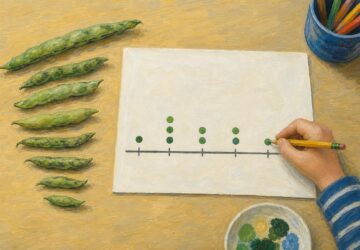
Math Line Plot: Each Mark a Measurement, Each Stack a Count
A line plot turns nine bean pod lengths into visible counts. Learn what marks and stacks mean, then build your own with fractions. See the worked example.
Reading a Linear Graph: Why the Slope Stays the Same
Understand a linear graph through constant slope, intercepts, and y = mx + b. Turn equations into points you can plot with confidence. See how it works.
Scatter Plot Reading: Steepness Isn’t the Whole Story
A scatter plot's slope can look persuasive while its dots tell another story. Learn to judge strength, clusters and display choices. Read the article.
Forest Plot: Why Pooled Results Can Tell a Clearer Story
A forest plot can show uncertain trials but a clearer pooled result. Learn what the diamond and study lines reveal about treatment benefits. Read the guide.