Pattern Recognition and Neural Networks Review
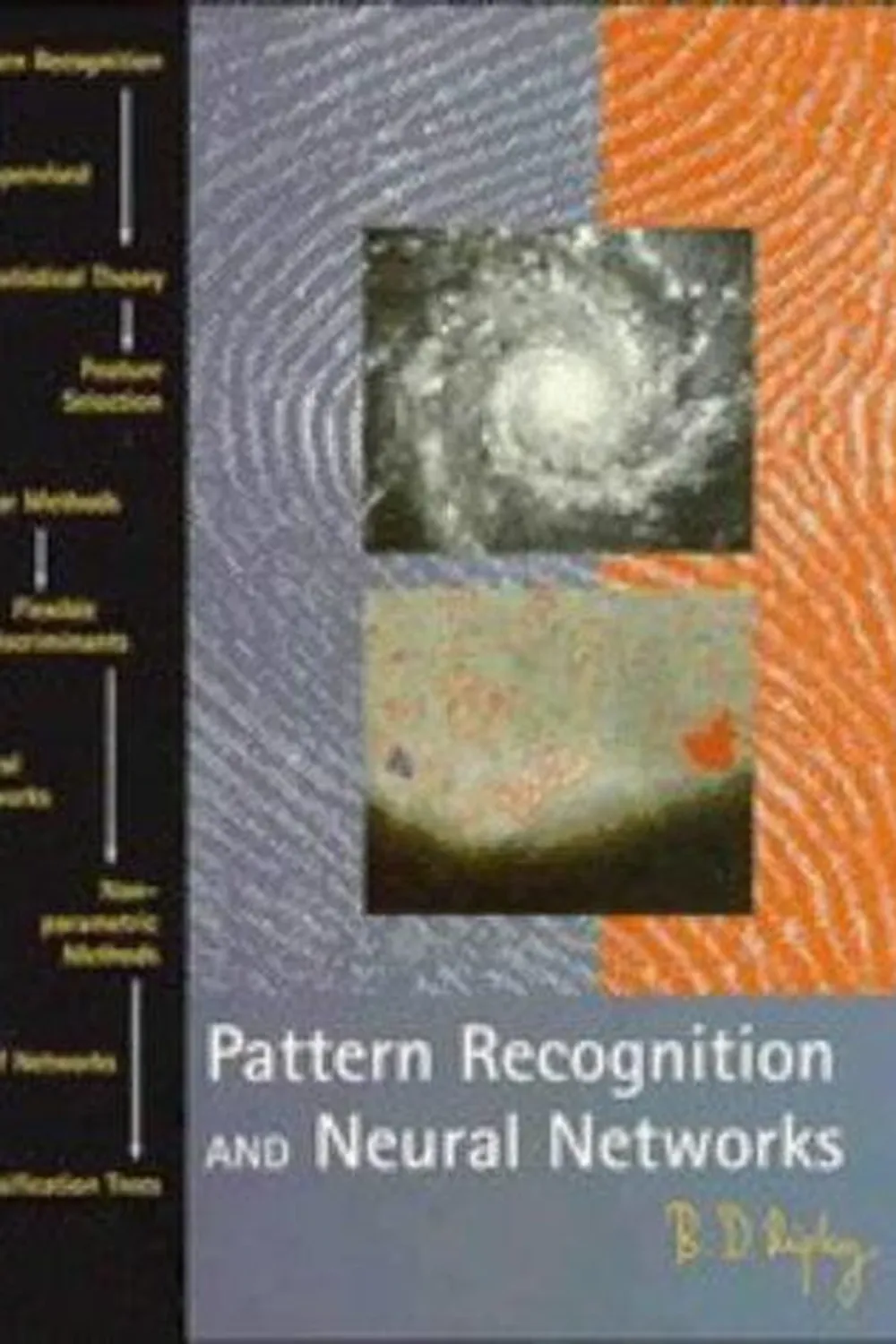
Pattern Recognition and Neural Networks by Brian D. Ripley is a statistical view of neural networks for classification and regression. It emphasizes inference, regularization, and diagnostics rather than hype.
Overview
Core topics: perceptrons, multilayer feedforward nets, training by gradient methods, regularization and model selection, generalized linear models, and comparisons with classical classifiers. Practical chapters discuss data preprocessing, feature scaling, and uncertainty estimation.
Summary
Ripley derives networks as flexible function approximators and connects them to statistical ideas: likelihood, penalization, bias–variance, and bootstrap diagnostics. He contrasts neural nets with kNN, trees, discriminant analysis, and support vector methods of the era. Examples illustrate overfitting control and performance assessment beyond raw accuracy.
Authors
Brian D. Ripley is a statistician known for rigorous, implementation-aware writing. The treatment is mathematical but practical.
Key Themes
Neural networks as statistical models; regularization and validation as first-class tools; comparisons grounded in loss and uncertainty.
Strengths and Weaknesses
Strengths: clear statistical framing, careful evaluation, and sober comparisons. Weaknesses: pre-deep-learning architectures and limited coverage of convolutional and sequence models. Still valuable for fundamentals.
Target Audience
Readers who want neural networks explained with statistical discipline and practical checks.
Favorite Ideas
Penalty terms as capacity control; bootstrap for uncertainty; side-by-side baselines to avoid cargo-cult enthusiasm.
Takeaways
Treat networks as estimators with bias and variance. Control capacity, validate thoroughly, and compare against simpler models.