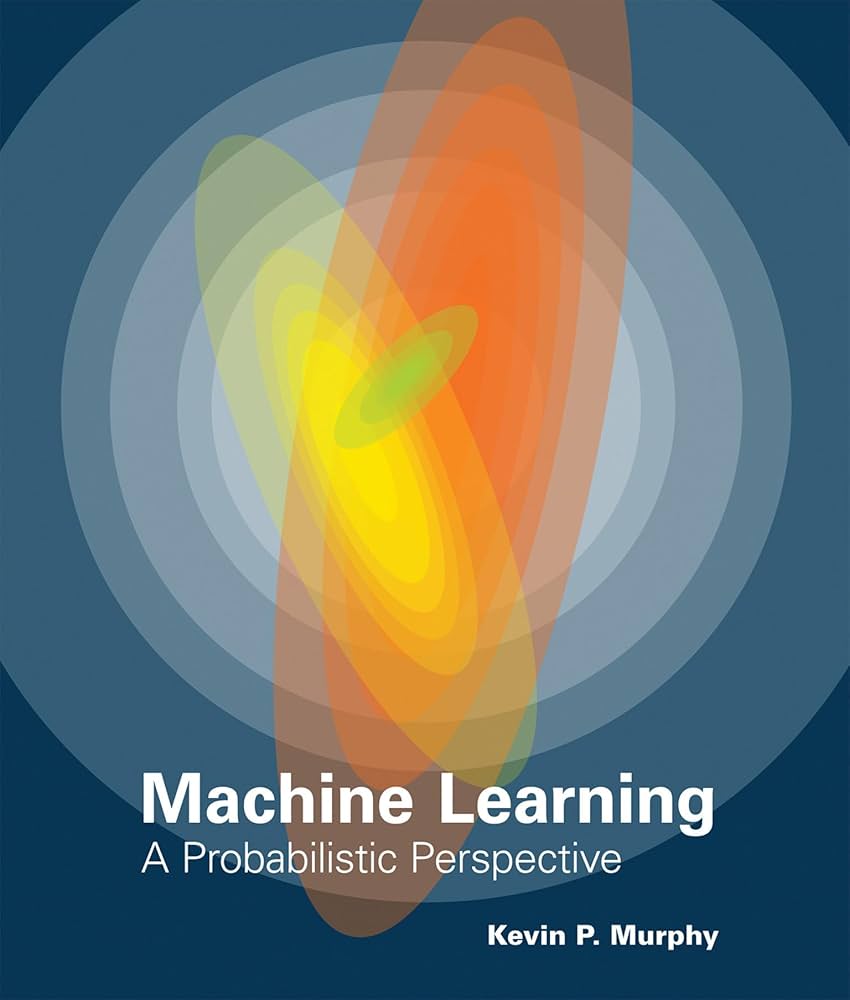
Machine Learning: A Probabilistic Perspective Review
Machine Learning: A Probabilistic Perspective by Kevin P. Murphy is an encyclopedic, model-first textbook that treats ML as probabilistic modeling plus optimization. It’s exhaustive, consistent, and unapologetically Bayesian-leaning.
Overview
Topics span supervised learning (linear models, GLMs, kernels, trees/ensembles), graphical models, latent-variable models, variational/MCMC inference, temporal models, and touches on deep learning and decision-making (RL basics).
Summary
Murphy develops common notation, then walks from simple generative/discriminative models to structured models with approximate inference. Expect clear derivations, algorithm boxes, and practical notes on priors, regularization, and evaluation. Emphasis on connecting loss, likelihood, and posterior reasoning.
Authors
Kevin P. Murphy writes like an engineer-statistician: precise, thorough, and implementation-aware.
Key Themes
Unification via probability; trade-offs between expressiveness and tractability; approximate inference as the lingua franca; evaluation beyond accuracy.
Strengths and Weaknesses
Strengths: breadth with consistent notation, many worked examples, and strong inference toolkit. Weaknesses: depth limits in very recent deep learning, and size can overwhelm. Pair with focused papers and modern libraries.
Target Audience
Graduate students and practitioners who want a one-stop, principled reference they can keep returning to.
Favorite Ideas
Probabilistic interpretations of common algorithms; variational bounds as reusable building blocks; structured prediction via graphical models.
Takeaways
Think probabilistically, pick models that match mechanisms and data, and use approximate inference pragmatically. Clear assumptions plus calibrated evaluation yield trustworthy systems.