Pattern Classification Review
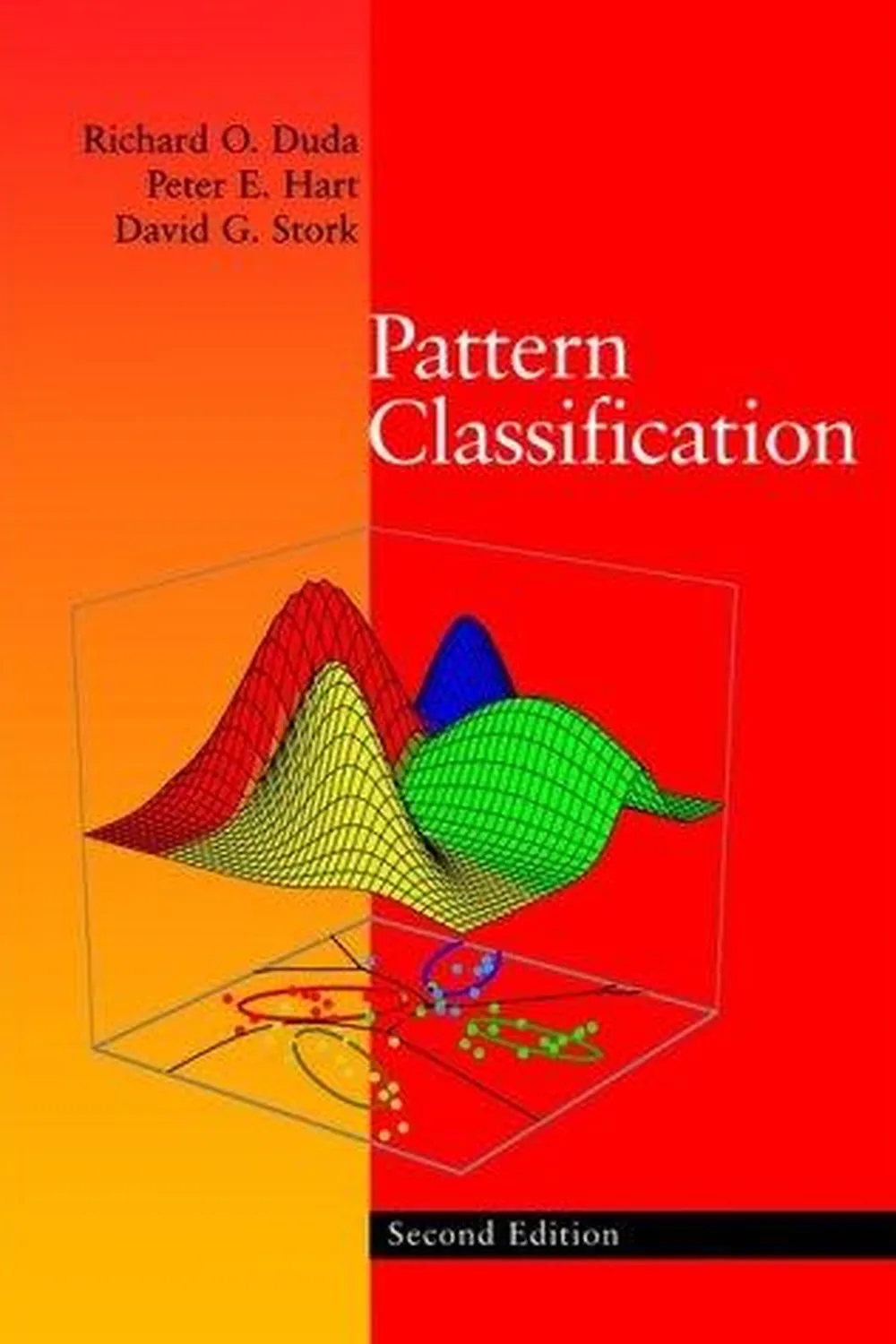
Pattern Classification by Richard O. Duda, Peter E. Hart, and David G. Stork is the classic comprehensive text on statistical pattern recognition. It unifies decision theory, feature extraction, and learning algorithms with clear geometry and proofs.
Overview
Coverage includes Bayes decision theory, parametric and nonparametric density estimation, discriminant functions, linear classifiers, neural networks, SVMs at an introductory level, dimensionality reduction, feature selection, clustering, and EM for mixtures.
Summary
The authors start from optimal decisions under known distributions, then relax assumptions and build practical methods: Gaussian classifiers, LDA and QDA, kNN, Parzen windows, perceptrons and MLPs, kernels and margins, and unsupervised learning via k-means and mixture models. They integrate bias–variance tradeoffs, VC ideas, and error bounds, with worked examples and exercises.
Authors
Duda, Hart, and Stork combine engineering intuition with statistical rigor. Exposition is careful and example-driven.
Key Themes
Decision theory as foundation; approximation when models are imperfect; features and dimensionality matter; validation and bounds guide trust.
Strengths and Weaknesses
Strengths: breadth, mathematical clarity, and durable intuitions. Weaknesses: limited modern deep learning and large-scale optimization details. Treat as a cornerstone to pair with newer texts.
Target Audience
Graduate students and practitioners needing a rigorous, method-spanning reference for classical recognition.
Favorite Ideas
Bayes risk as north star; LDA as geometry of variance; EM as a lens on latent structure.
Takeaways
Start from decision theory, choose features and models to match data and cost, and validate with methods that quantify error. The core principles generalize across toolchains.